Fried vs Non-Fried Instant Noodles: Where Texture Is Won or Lost
Instant noodle texture is not created at one step. It is built, stressed, and either protected or damaged across mixing, resting, sheeting, cutting, steaming, drying or frying, cooling, and packing.
For R&D and production teams, the key question is not simply whether a noodle is fried or non-fried. The real question is: where does the process create the texture you want, and where does it start to take it away?
As an enzyme supplier for noodle manufacturing, StrandPilot helps instant noodle producers translate flour variation, process route, and finished-product targets into practical enzyme strategies for dough handling, strand integrity, hydration behavior, bite firmness, and cooking consistency.
The process split: fried and non-fried noodles behave differently
Fried and non-fried instant noodles share many upstream steps. Both rely on controlled dough development, sheet formation, steaming, strand structure, and final moisture management. But once the noodle enters the final dehydration stage, the texture pathway changes sharply.
Fried instant noodles
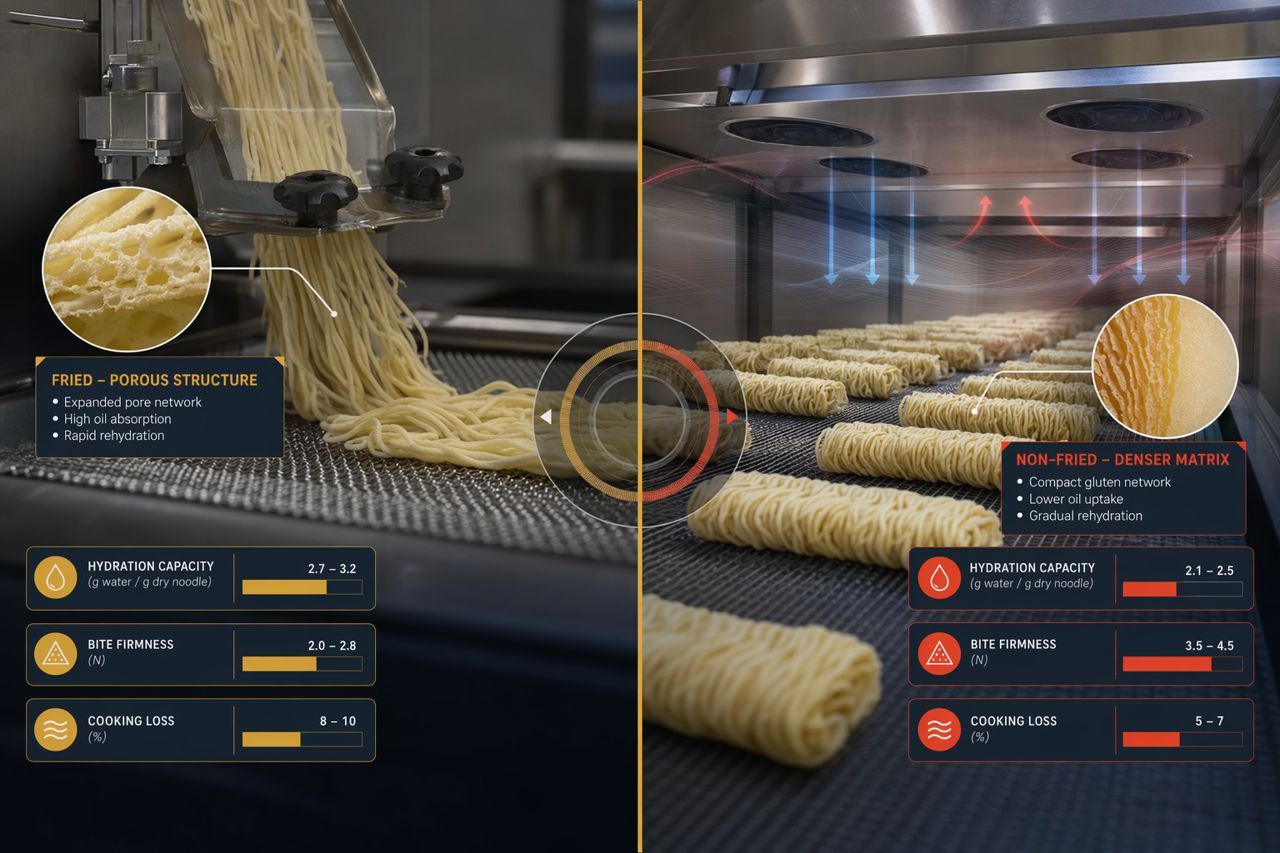
Fried noodles are dehydrated rapidly in hot oil. The process creates a porous structure that supports quick rehydration, familiar bite, and strong flavor delivery. However, oil frying can also amplify defects if the sheet structure is weak or if the steamed noodle does not hold its geometry.
Common texture risks include:
- excessive brittleness after cooling
- uneven rehydration in the cup or bowl
- soft bite after holding
- high cooking loss or cloudy soup
- strand breakage during block forming and packaging
- oil uptake variation caused by inconsistent structure
Non-fried instant noodles
Non-fried noodles typically rely on hot-air drying or other lower-oil dehydration systems. They can support cleaner label positioning and a different nutritional profile, but the process is less forgiving. Drying is slower than frying, and the noodle structure must survive longer exposure to heat, airflow, and moisture gradients.
Common texture risks include:
- dense bite or slow hydration
- surface checking or micro-cracking
- uneven moisture removal across the block
- strand deformation during drying
- weak elasticity after cooking
- higher sensitivity to flour variation
Where texture is won: dough rheology before steaming
Before frying or drying, the noodle has already made several important texture decisions.
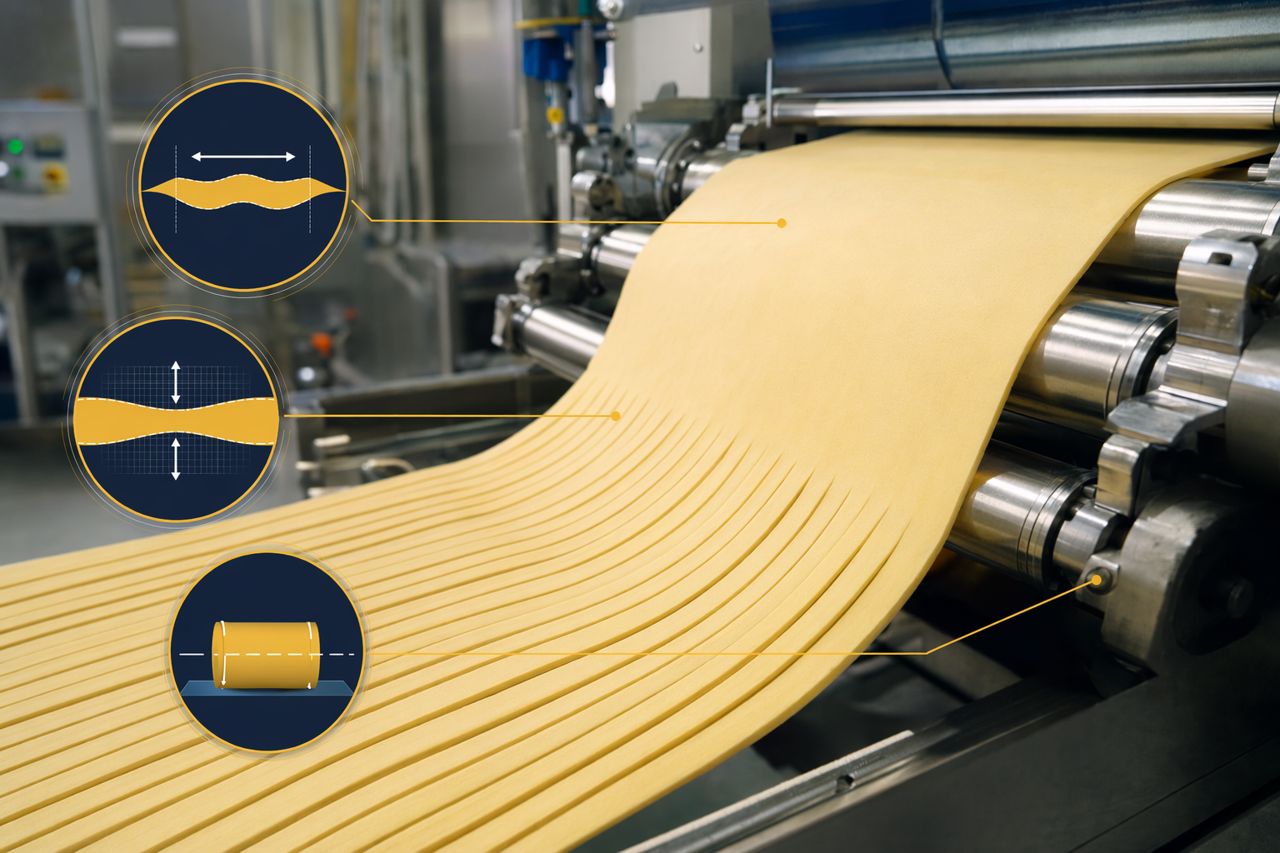
The dough sheet must be extensible enough to pass through rollers without tearing, but strong enough to maintain strand definition. If the dough is too tight, sheeting becomes unstable and cutting quality suffers. If it is too weak, strands can deform, stick, or break.
Enzyme systems can support this balance by helping R&D teams tune:
- dough relaxation during sheeting
- extensibility without collapse
- sheet smoothness and gloss
- strand separation after cutting
- tolerance to flour protein variation
- stability during line speed changes
The target is not a generic softer or harder dough. The target is a dough window that stays workable across production realities.
Steaming: the checkpoint for final eating quality
Steaming is where the noodle’s internal structure becomes more fixed. Starch gelatinization, protein network behavior, and moisture migration combine to define how the noodle will later dry, fry, and rehydrate.
For fried noodles, steaming quality influences expansion, porosity, and how uniformly oil replaces water during frying.
For non-fried noodles, steaming quality influences drying resilience, final firmness, and how quickly hot water can re-enter the noodle during preparation.
If steaming is inconsistent, downstream process adjustments can only compensate so much. Texture loss often appears later, but the root cause may have started here.
Fried noodles: texture gains and texture risks
Frying can be an advantage because it builds a porous matrix that helps the finished noodle hydrate quickly. This is one reason fried instant noodles often deliver fast eating readiness and familiar spring.
But frying also exposes weak process control quickly.
What frying can improve
- rapid dehydration
- open pore structure
- fast hot-water uptake
- characteristic fried aroma and bite
- stable block formation when strand structure is strong
What frying can damage
- strand strength if the dough sheet is underdeveloped or over-relaxed
- bite firmness if porosity becomes too open
- sensory consistency if oil uptake varies
- package durability if the block becomes too brittle
- soup clarity if structure releases excess solids during preparation
For fried noodle manufacturers, enzyme strategy often focuses on achieving a stronger, more consistent upstream structure before frying, so the oil step enhances texture rather than exposing weakness.
Non-fried noodles: texture gains and texture risks
Non-fried noodles need a different formulation mindset. Without the same oil-driven pore formation, the noodle must be engineered to hydrate efficiently while still delivering bite and elasticity.
What non-fried processing can improve
- lower-oil product positioning
- clean, wheat-forward sensory profile
- controlled firmness and chew
- differentiated texture compared with fried noodles
- flexibility for premium and health-oriented products
What non-fried processing can damage
- hydration speed if the structure becomes too dense
- elasticity if drying stress weakens the strand
- block appearance if strands warp or crack
- eating quality if the core remains firm while the surface softens
- scale-up consistency if drying airflow and moisture gradients vary by line
For non-fried manufacturers, enzyme support often focuses on dough strength, controlled relaxation, hydration behavior, and resilience through drying.
The hidden issue: flour variation changes both process routes
Instant noodle factories rarely work with perfectly identical flour. Protein level, starch damage, ash content, granulation, and seasonal wheat changes can all affect noodle performance.
The same flour change may appear differently depending on the process route:
- In fried noodles, it may show up as block fragility, oil uptake variation, or soft bite.
- In non-fried noodles, it may show up as slow rehydration, cracking, or dense texture.
This is where enzyme formulation support becomes valuable. A practical enzyme system gives R&D and production teams a controlled way to narrow variability without redesigning the entire recipe every time flour behavior shifts.
Texture targets should be defined before enzyme selection
A useful enzyme program starts with the finished product brief, not the ingredient list.
For instant noodle manufacturers, typical targets include:
- firm bite after standard preparation
- elastic chew without gumminess
- fast and even hydration
- low cooking loss and clear soup
- stable strand length after handling
- reduced breakage through packing and transport
- consistent texture after shelf life
- reliable performance across line speeds
Once these targets are clear, StrandPilot helps map the process points where enzyme action can create measurable production value.
Practical enzyme opportunities in instant noodle production
Every factory has its own flour base, equipment layout, and target texture. Still, several formulation areas are common across fried and non-fried instant noodle production.
1. Dough handling and sheeting stability
Enzyme systems can help manage dough relaxation, sheet strength, and roller response. The commercial value is fewer line interruptions, cleaner sheets, better strand definition, and a wider operating window.
2. Strand integrity during cutting and forming
Good strand integrity supports block shape, reduces breakage, and improves packaging performance. This matters especially when manufacturers are scaling a new SKU or moving between flour lots.
3. Rehydration behavior
For fried noodles, the goal may be rapid hydration without excessive softness. For non-fried noodles, the goal may be faster water uptake while preserving firmness. Enzymes can be part of a structured approach to balancing these outcomes.
4. Bite firmness and elasticity
Texture is a sensory promise. Whether the target is springy, firm, smooth, chewy, or soft, enzyme selection should support a repeatable bite profile after cooking or cup preparation.
5. Cooking loss and soup clarity
A noodle that releases too much solid material during preparation can reduce soup clarity and weaken bite. Enzyme formulation can help support internal structure so the noodle performs more cleanly in the bowl.
Fried vs non-fried: what R&D should compare during trials
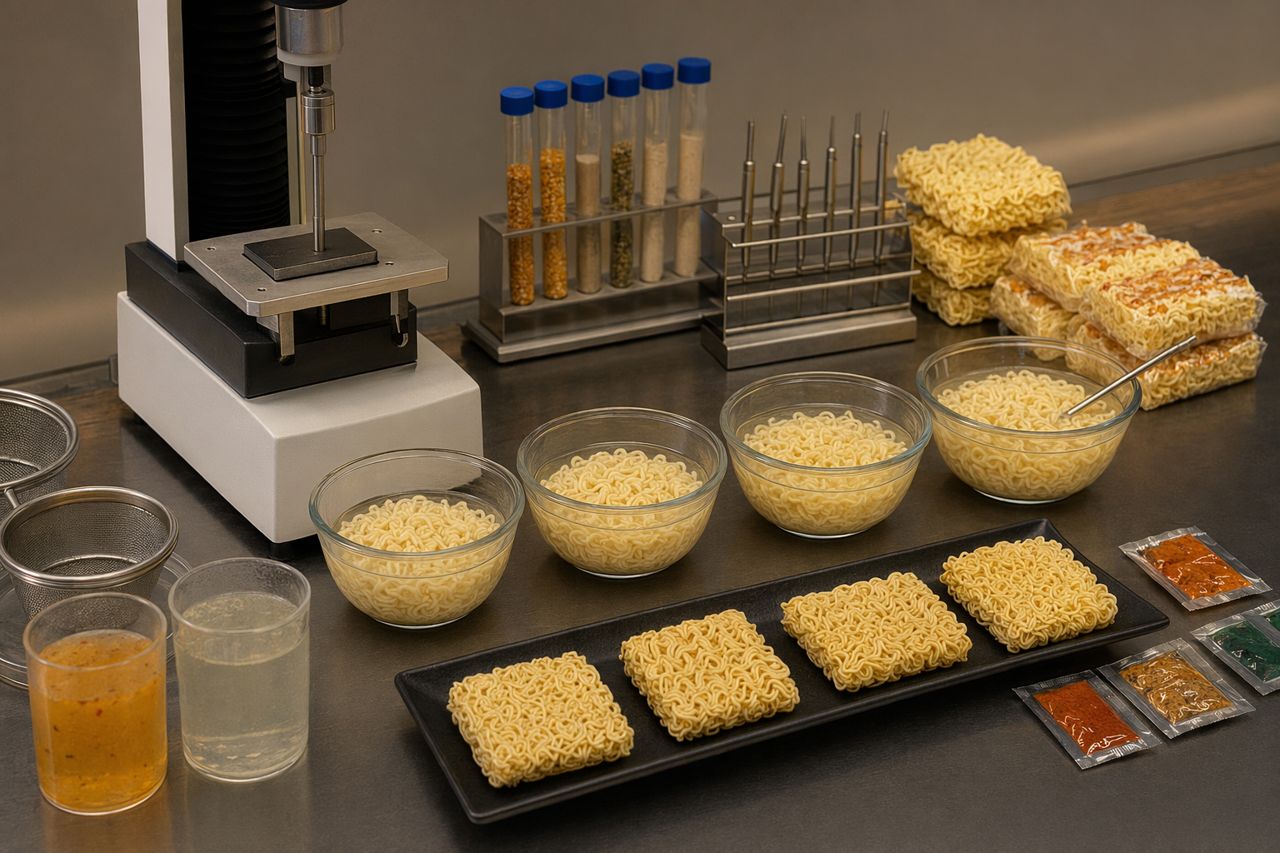
When comparing process routes or reformulating an existing noodle, R&D teams should evaluate both line behavior and finished product behavior.
On the line
- dough sheet smoothness
- roller stability
- cutting cleanliness
- strand separation
- block forming consistency
- steaming response
- drying or frying uniformity
- breakage before packing
In the finished product
- hydration time perception
- bite firmness
- elasticity and rebound
- surface smoothness
- cooking loss
- soup clarity
- strand length after preparation
- texture stability during holding
The strongest formulation is not always the one that performs best in a lab dough. It is the one that survives the factory line and still delivers the target bite to the consumer.
Scale-up: the step where promising textures can drift
A noodle that works in a small trial can behave differently on a full production line. Longer dough residence, higher sheet stress, different steaming intensity, larger block geometry, and real drying or frying conditions can shift texture outcomes.
StrandPilot supports scale-up by helping manufacturers connect formulation choices to process observations. That means looking at the full pathway:
- flour and water absorption behavior
- dough development and resting
- sheeting and cutting stability
- steaming response
- frying or drying stress
- finished block durability
- preparation performance
- sensory consistency after storage
This approach helps teams avoid treating enzyme selection as a single ingredient swap. It becomes a controlled process tool.
How StrandPilot works with noodle manufacturers
StrandPilot provides enzyme solutions and application support for noodle factories that need predictable performance at production scale.
Our work typically includes:
- reviewing the target product brief and current pain points
- identifying whether the main challenge is dough handling, hydration, bite, breakage, or cooking loss
- recommending enzyme options suitable for fried or non-fried processing
- supporting pilot trials with clear comparison criteria
- helping refine dosage windows without disrupting factory workflow
- translating trial observations into scale-up recommendations
The outcome is practical: fewer surprises between R&D and production, clearer texture control, and a stronger route from formulation decision to factory result.
The takeaway
Fried and non-fried instant noodles do not simply differ at the final dehydration step. They differ in how every earlier process decision expresses itself in the finished texture.
Fried noodles need structure that can benefit from rapid dehydration and oil-driven porosity. Non-fried noodles need structure that can withstand drying stress while still hydrating quickly and eating well.
In both routes, enzymes can help manufacturers control the dough-to-strand pathway with more precision.
If your team is developing a new instant noodle, troubleshooting texture drift, or comparing fried and non-fried process routes, StrandPilot can help you define the right enzyme strategy for your line.
Request a quote to discuss your noodle format, process route, and target texture with the StrandPilot team.