How Flour Variability Shows Up on Instant Noodle Lines
Instant noodle lines are built for rhythm: mixing, sheeting, cutting, steaming, frying or drying, cooling, and packing. Flour variability interrupts that rhythm before it looks like a formulation problem.
A new flour lot may meet purchasing specifications and still behave differently under hydration, compression, steaming, or oil exposure. For R&D and production teams, the challenge is not simply identifying that flour has changed. The real task is converting that variability into controllable process decisions.
StrandPilot supports noodle manufacturers with enzyme systems designed around dough handling, strand integrity, bite, cooking performance, and scale-up repeatability. As an enzyme supplier for noodle manufacturing, we help teams connect flour behavior to practical texture and line outcomes.
The first signal is usually not in the lab report
Flour certificates can show acceptable protein, moisture, ash, and gluten indicators, yet the line may still feel different. Operators may notice dough that tightens too early, sheets that resist smooth reduction, or strands that lose definition after steaming.
Common line observations include:
- Dough sheets that become too elastic, too short, or uneven across the width
- Increased edge cracking or surface checking during reduction
- Strand breakage at cutting, transfer, or wave-forming
- Noodle blocks that deform during steaming, drying, or frying
- Higher cooking loss or cloudy cooking water
- Bite that drifts from firm-elastic to brittle, pasty, or weak
- Longer changeover time while teams adjust water, mixing, roll gaps, or steaming conditions
These are production symptoms of flour behavior. The cost is not only waste. It is also lost line stability, slower troubleshooting, and sensory inconsistency between batches.
Where flour variability enters instant noodle production
Flour performance on a noodle line is shaped by several interacting variables. Protein level matters, but it is not the whole story. Gluten quality, starch damage, particle size distribution, native enzyme background, water absorption, and seasonal wheat blends can all influence dough response.
1. Hydration behavior
A flour lot that absorbs water faster or slower can shift dough development before the sheet reaches the first rollers. Too little functional hydration can produce rough sheets and weak strand definition. Too much or too rapid hydration can increase stickiness and reduce clean transfer.
R&D teams often see this as a moving water target. Production teams see it as operators chasing the dough.
2. Sheet extensibility and elasticity
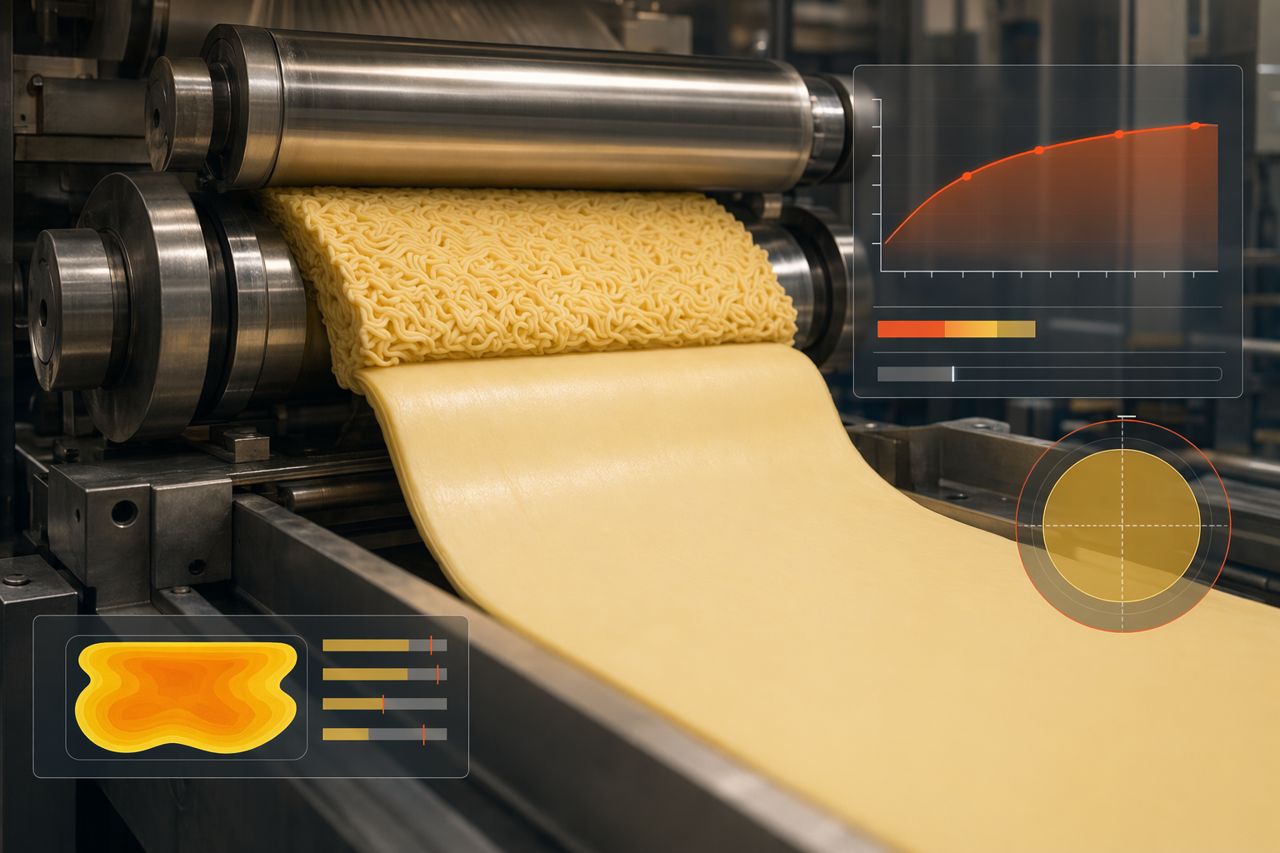
Instant noodle dough must tolerate repeated compression. If the gluten network is too tight, the sheet may spring back and resist gauge reduction. If it is too weak, the sheet may tear, smear, or lose strand geometry.
The target is not maximum strength. It is controlled elasticity: enough structure for cutting and cooking, with enough extensibility for stable sheeting.
3. Starch response during steaming and cooking
Starch behavior influences surface texture, gelatinization, block formation, rehydration, and cooking loss. Variability in starch damage or flour granulation can change how the noodle surface sets in steam and how it releases solids during consumer cooking.
The same formula may produce a clean bite on one flour lot and a softer, cloudier cook on the next.
4. Frying or drying sensitivity
For fried noodles, flour variability can affect oil interaction, block expansion, surface texture, and post-fry firmness. For air-dried noodles, it can affect drying stress, cracking risk, and final rehydration behavior.
When the dough network and starch matrix are not aligned, downstream thermal steps amplify small upstream differences.
Why simple formulation adjustments are not always enough
Water, salt, alkali, mixing time, roll reduction, steaming profile, and drying or frying conditions all provide useful control points. But when flour changes frequently, relying only on mechanical correction can create new issues.
For example:
- More water may improve sheet smoothness but increase stickiness
- Longer mixing may develop structure but reduce extensibility
- Tighter roll settings may improve thickness control but raise breakage risk
- More steaming may improve setting but soften bite or increase block deformation
A well-designed enzyme approach gives R&D teams another lever. The goal is not to force every flour to behave identically. The goal is to narrow the behavior window so the line can run predictably.
How enzyme systems help manage flour variability
Enzymes can support noodle manufacturing by selectively modifying dough and starch interactions during processing. The right system depends on the flour, noodle style, process type, and target texture.
StrandPilot focuses on practical production outcomes:
- More consistent dough handling across flour lots
- Improved sheet smoothness during reduction
- Better strand continuity through cutting and transfer
- Controlled bite firmness and elasticity after cooking
- Reduced cooking loss and surface breakdown
- More stable rehydration performance
- Faster scale-up from bench trial to plant run
The emphasis is always on dosage window, process tolerance, and finished noodle quality. A useful enzyme system must fit the line, not the other way around.
What to check when a flour lot changes
When a new flour lot creates instability, start with the process signals closest to the line. A structured review helps separate flour-driven behavior from operator adjustment, equipment drift, or formulation error.
R&D and production checklist
- Compare dough feel at fixed water and mixing conditions.
- Record sheet surface quality after each reduction stage.
- Track springback, edge cracking, and sheet width stability.
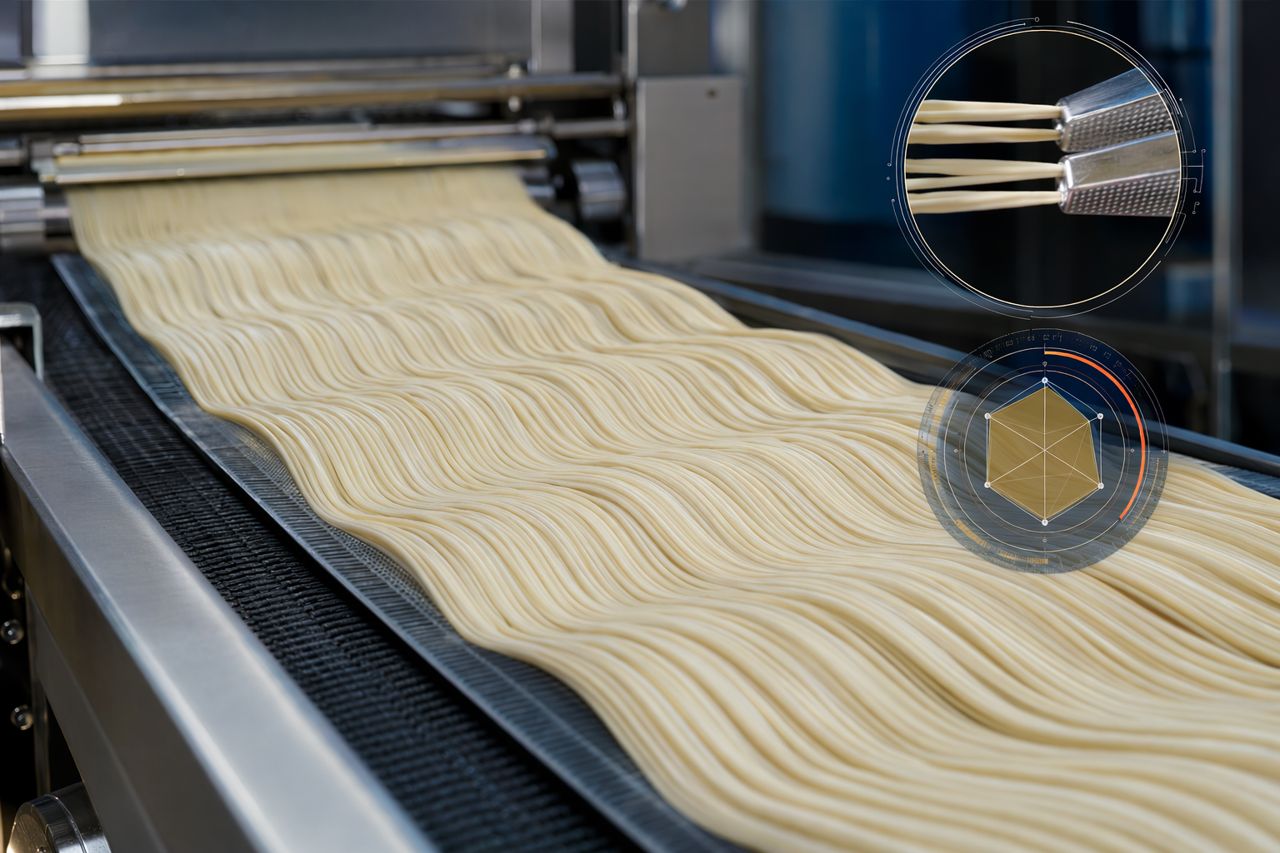
- Observe strand separation and breakage after cutting.
- Review steaming set, surface condition, and block shape.
- Compare cooked bite, elasticity, and chew-down across lots.
- Measure cooking water clarity and solids release as internal quality indicators.
- Confirm whether the issue appears before or after thermal processing.
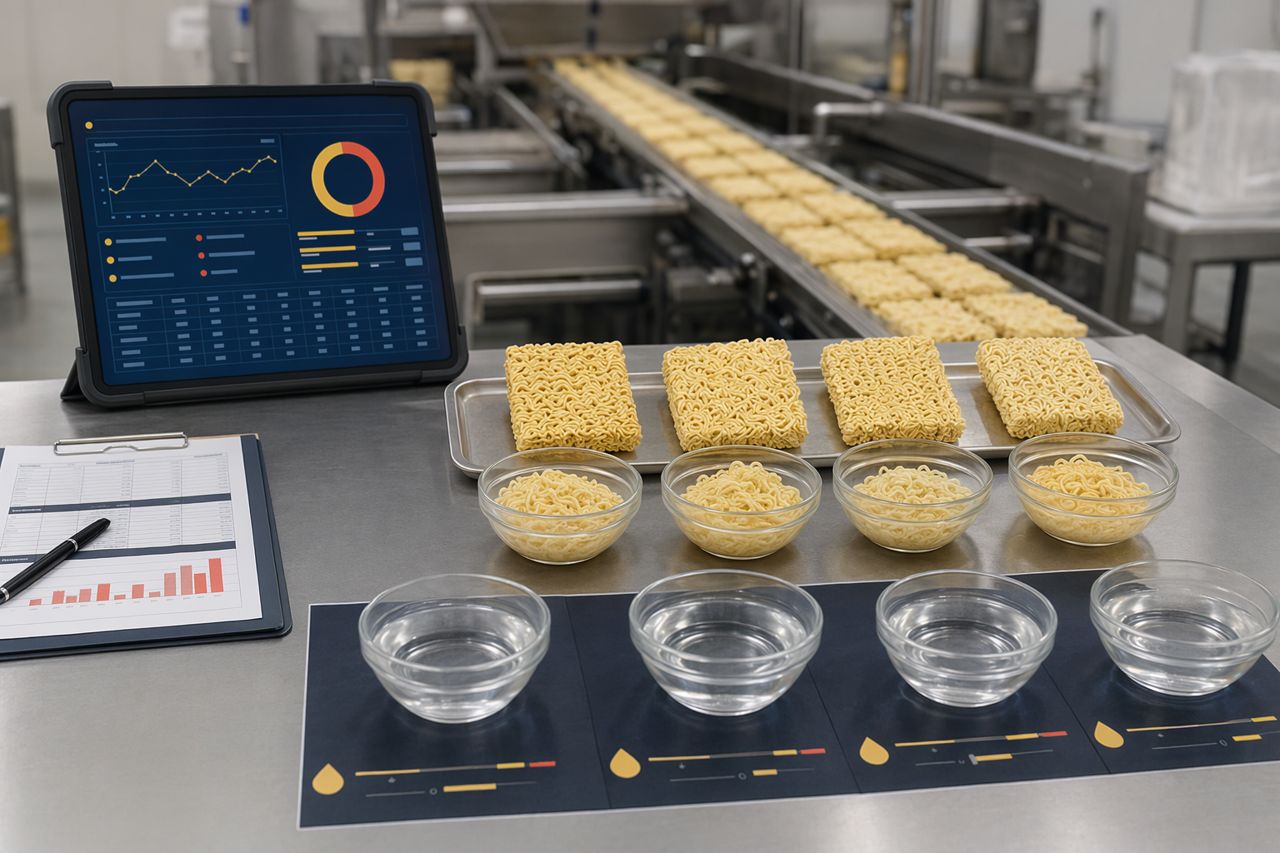
- Run a controlled enzyme screening before changing multiple formula variables.
The key is to avoid changing everything at once. Flour variability becomes manageable when each symptom is linked to a likely mechanism.
Matching enzyme strategy to the symptom
Different symptoms point to different formulation directions. The table below gives a practical starting point for discussion.
| Line symptom | Likely process concern | Enzyme strategy focus |
|---|---|---|
| Tight sheet, high springback | Dough too elastic or resistant during reduction | Improve extensibility and sheeting tolerance |
| Rough surface or edge cracking | Uneven hydration or weak sheet formation | Support smoother dough development |
| Strand breakage | Insufficient network continuity or poor transfer resilience | Improve strand integrity and handling strength |
| Soft or pasty cooked bite | Weak texture set or excess surface breakdown | Support firmness, elasticity, and starch structure |
| Cloudy cooking water | Higher solids release during cooking | Reduce cooking loss and improve surface stability |
| Variable block shape | Inconsistent setting through steaming and drying/frying | Stabilize dough response before thermal steps |
This is where supplier support matters. A catalog enzyme is rarely enough for a high-speed noodle factory. The system must be selected and tuned against your flour range, noodle format, and line constraints.
What StrandPilot brings to noodle R&D teams
StrandPilot works with manufacturers that need technical support beyond sample shipment. Our role is to help R&D and production teams turn flour variability into a defined trial plan.
We support:
- Flour-lot comparison and symptom mapping
- Enzyme selection based on texture and process targets
- Bench and pilot screening design
- Plant-trial guidance for dosage window and process fit
- Sensory alignment for bite, elasticity, and mouthfeel
- Scale-up support for instant noodle, cup noodle, bowl noodle, fried noodle, and air-dried noodle formats
Our recommendations are built for manufacturing reality: ingredient cost, dosing practicality, processing tolerance, and repeatable finished quality.
A better way to handle the next flour change
Flour variability will not disappear. Wheat seasons change, milling behavior changes, and procurement flexibility remains part of noodle manufacturing. The advantage comes from having a repeatable response.
When the next flour lot arrives, the question should not be, why is the line different today? It should be, which control lever brings this dough back into the target window with the least disruption?
That is the StrandPilot approach: precise enzyme systems, practical trial support, and texture outcomes that R&D and production teams can verify on the line.
Request a quote
Planning a flour-lot trial, reformulation, or line-stability project? Share your noodle format, process type, target texture, and current production symptoms through the on-site request a quote form. StrandPilot will help you identify an enzyme strategy suited to your manufacturing conditions.